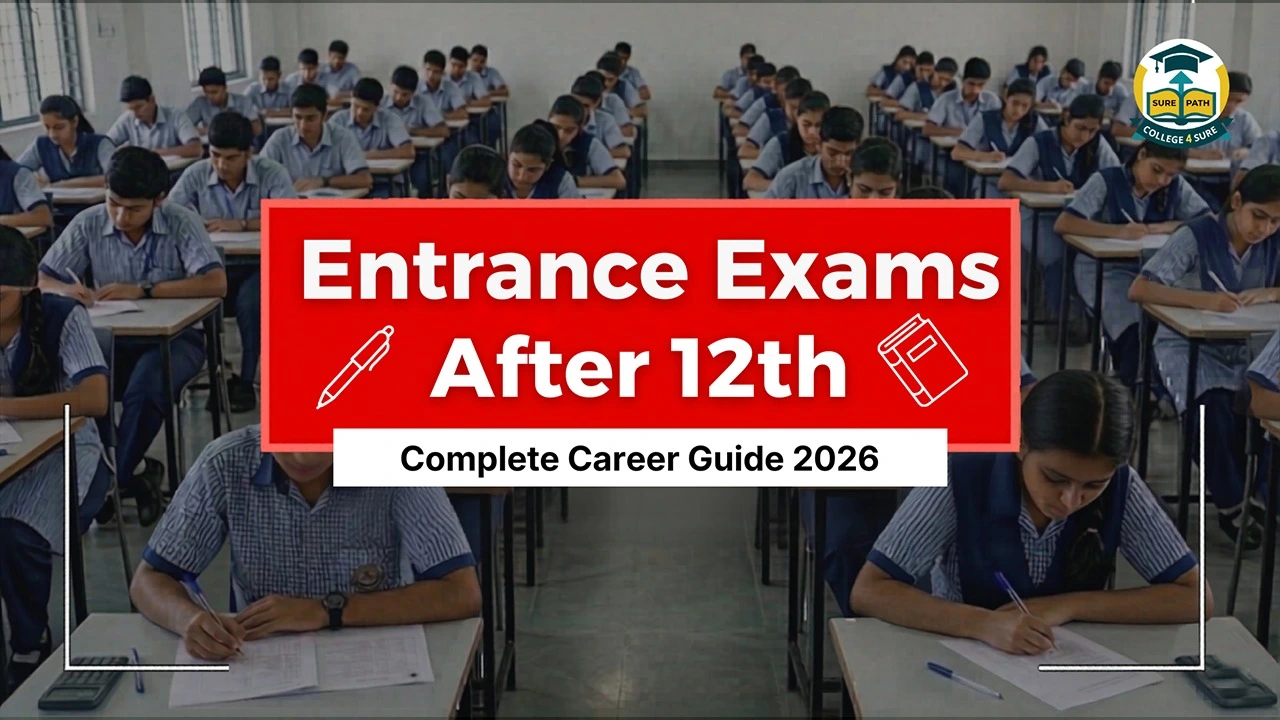
Entrance Exams After 12th: Complete Career Guide 2026
As soon as the 12th grade passes, students in India find themselves amidst some of the most crucial stages of their academic career. With the increase in applicants and changes in various professions, simply clearing the Board exam is not sufficient as it won’t be able to fetch enough credits for you. This is where the entrance exams for after 12th in India come into play and are critical to gaining access to superior institutions, as well as to many of the highest-demand careers such as engineering, medicine, law, business, and design.
Over the past few years, the importance of entrance exams has grown exponentially, as they provide an equal and standard method for selecting candidates. As opposed to relying on the marks obtained from your board exams, entrance exams measure each student's conceptual understanding, analytical ability, and problem-solving skills. Because there are several lakh students who register to take the entrance exam each year, understanding the most important competitive and description of the entrance exams you need to pass for after 12th Grade is extremely valuable when trying to determine what type of career to pursue.
Why Entrance Exams After 12th Are Important
Standardized tests serve as the entrance examination for numerous students all throughout India. Rather than only looking at one’s board exam scores, entrance examinations measure one’s understanding of the subject matter, analytical abilities, and capacity for resolving difficulties.
They are important because:
- Aid in gaining access to the top colleges such as IITs (Indian Institutes of Technology), AIIMS (All India Institute of Medical Sciences), NLUs (National Law Universities).
- Create an atmosphere of equitable competition amongst students from all over the country.
- Grant access to jobs that are in high demand.
- They enable students to obtain admission through merit-based systems.
Each year, numerous applicants apply for limited seats, making preparation for the exams and being informed about the exams even more important than in previous years.

Major Entrance Exams After 12th
A compiled table that includes the primary entrance examinations by stream along with actual applicant numbers has been compiled.
|
Exam Name |
Stream |
Courses Offered |
Conducting Body |
Approx Applicants (Yearly) |
|
JEE Main |
Engineering |
B. Tech, B.E. |
NTA |
12–14 lakh |
|
JEE Advanced |
Engineering |
IIT Admissions |
IITs |
1.5–2 lakh |
|
NEET UG |
Medical |
MBBS, BDS |
NTA |
20–24 lakh |
|
CUET UG |
All Streams |
BA, B. Com, BBA |
NTA |
15 lakhs |
|
CLAT |
Law |
BA LLB |
Consortium of NLUs |
70,000+ |
|
NDA |
Defence |
Army, Navy, Air Force |
UPSC |
5–6 lakh |
|
BITSAT |
Engineering |
B. Tech |
BITS Pilani |
3–3.5 lakh |
|
IPMAT |
Management |
Integrated MBA |
IIMs |
30,000–40,000 |
As illustrated in the table, competition among these examinations is significant and highlights why adequate time to prepare is essential.
Engineering Entrance Exams After 12th
One of India's most popular career tracks is a career in engineering. Students can take these tests after studying for some type of science-related subject, such as math and physics (Eighth Grade onward).
|
Exam Name |
Conducting Body |
Courses Offered |
Approx Applicants (Yearly) |
Difficulty Level |
|
JEE Main |
NTA |
B.Tech, B.E., B.Arch |
12+ lakh |
High |
|
JEE Advanced |
IITs |
IIT Admissions |
2.5 lakh (qualified) |
Very High |
|
BITSAT |
BITS Pilani |
Engineering |
2 lakhs |
High |
|
VITEEE |
VIT University |
B.Tech |
3–4 lakh |
Moderate |
|
SRMJEEE |
SRM University |
B.Tech |
2–3 lakh |
Moderate |
The major highlights are:
- The JEE Main (or "Joint Entrance Exam for Engineering") is by far the most widely accepted engineering entrance examination in India.
- Entry into the JEE Advanced level for joining an IIT requires entry into the JEE Main on a limited entry basis based on "ranking.".
- Many private engineering universities have established their own independent entrance tests (e.g., BITSAT (BITS U) and VITEEE).
Types of Careers in Engineering include:
- Computer Engineer
- Mechanical Engineer
- Civil Engineer
- Data Scientist
Medical Entrance Exams After 12th
Careers in medicine can be pursued by students who took the Science (PCB) group.
|
Exam Name |
Conducting Body |
Courses |
Applicants (Approx) |
Competition Level |
|
NEET-UG |
NTA |
MBBS, BDS |
20+ lakh |
Extremely High |
|
AIIMS (via NEET) |
NTA |
MBBS |
Included in NEET |
Very High |
|
JIPMER (via NEET) |
NTA |
MBBS |
Included in NEET |
Very High |
The major highlights are:
- NEET is the sole medical entrance exam in India, with national credibility.
- There are three core subjects: Physics, Chemistry and Biology.
- NEET is among the most competitive exams in India.
Types of Careers in Medical include:
- Doctor (MBBS).
- Dentist
- Pharmacist
- Medical Researcher
Law Entrance Exams After 12th
The field of law is rapidly expanding and offers many opportunities for employment to individuals who are trained in law.
|
Exam Name |
Conducting Body |
Courses |
Colleges Covered |
|
CLAT |
Consortium of NLUs |
BA LLB, BBA LLB |
22+ NLUs |
|
AILET |
NLU Delhi |
BA LLB |
NLU Delhi |
|
LSAT India |
LSAC |
Law Programs |
Private Colleges |
The major highlights are:
- CLAT is the largest law entrance examination.
- AILET is a very competitive examination but you can only apply to one university.
- All examinations included testing on GK, English, Legal Reasoning and Logical Ability
Types of Careers in Law include:
- Lawyers
- Corporate Legal Advisors
- Judges (after additional examination)
- Legal analysts
Management Entrance Exams After 12th
Business and management students may choose to pursue either BBA or integrated MBA programs.
|
Exam Name |
Conducting Body |
Courses |
Top Institutes |
|
IPMAT |
IIM Indore/Rohtak |
Integrated MBA |
IIMs |
|
CUET UG |
NTA |
BBA, B.Com, BA |
Central Universities |
|
NPAT |
NMIMS |
BBA |
NMIMS |
The major highlights are:
- CUET tools are frequently utilized for admitting candidates to central universities.
- Incorrect answers will receive a -1 mark.
- Total score depends on the choice of subject.
- IPMAT is extremely competitive for admission to IIMs.
Types of Careers in Management include:
- Business Management Executive
- Entrepreneurship
- Marketing Executive
- Financial Analyst
Design Entrance Exams After 12th
Students who are creative can have careers in many areas like; clothing fashion, internet user experience (UI/UX), product design, etc.
|
Exam Name |
Conducting Body |
Courses |
|
NIFT Entrance Exam |
NIFT |
Fashion Design |
|
NID DAT |
NID |
Industrial Design |
|
UCEED |
IIT Bombay |
Design (B.Des) |
Types of Careers in Design include:
- Fashion Designer
- UI/UX Designer
- Product Developer (3D Modeler / Modeler)
- Graphic Designer
Government & Defence Exams After 12th
Students interested in Serving their Country may take the DEFENSE EXAM.
|
Exam Name |
Conducting Body |
Career Path |
|
NDA |
UPSC |
Army, Navy, Air Force |
|
SSC CHSL |
SSC |
Government Jobs |
|
Railway Exams |
RRB |
Technical/non-technical roles |
The major highlights are:
- The NDA will provide access to a senior defines officer.
- The applicant's record and physical fitness must be verified.
How to Choose the Right Entrance Exam
It is also necessary that you do not just base your choice of entrance exams on what is currently prevailing, but at the same time, know your interests. For this reason, students should evaluate their previous education level, career goals and aptitude prior to making a decision.
If you are someone who has a love for Mathematics and likes working with solving problems then an engineering career might work out well for you. If you have a love of Biology and want to work in the medical field then a medical career may suit your needs better. For example, those that have good reasoning and communication skills may find success in becoming attorneys or entering into management.
Many students also want to see what else is available and can apply to different entrance exams so they have multiple opportunities to enter a college or university that has a good program for their desired area of study.
Preparation Strategy for Entrance Exams
Being disciplined and punctual should be the first criteria to be met by a student before taking entrance exams. This means that a student should begin his preparation process having information about the pattern and syllabus of the entrance exam. The basics of most entrance examinations are based on NCERT concepts, thus building up a strong basis.
Practicing regularly by taking mock tests and solving past year question papers improves the speed and accuracy of the student. Another important aspect is that many entrance exams are time bound and require quick decision making, hence, each student must be able to manage his time efficiently.
While it is apparent that academic [exam] preparation is a major factor in entrance exam success, it is equally important that students maintain good health and motivation to succeed in their accredited programs. Entrance examination preparation is often very taxing and students should focus on maintaining a balanced life.
Conclusion
Choosing a career path can be a daunting experience after completion of class 12. This phase also presents numerous opportunities while providing a great deal of competition among candidates. Additionally, entrance exams act as the main gateway to postgraduate programs and career options within various disciplines; these could potentially range from engineering or medical professions through law, management, or design.
By being knowledge about the various types of entrance examinations (12th Grade or Secondary School Diploma) currently available in India (or those offered internationally), how those tests will be structured and what level of competition exists for each examination would provide college-bound students with more confidence towards selecting their future professional course.
Additionally, students can easily break into succeeding in their respective fields with the right mix of preparation, commitment, and a willingness to succeed.
Frequently asked
Why are entrance exams important after 12th if I've already cleared my board exams?
Which entrance exam should I take for engineering after 12th?
What exam do I need for MBBS or BDS admission?
What is CUET UG and which courses does it cover?
Which entrance exam is needed for law courses after 12th?
How do I decide which entrance exam to prepare for?
Still deciding?
Talk it through with someone who has helped hundreds of students choose.